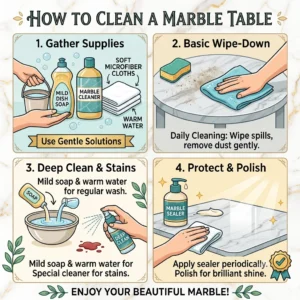
The easiest and safest way to clean a marble table is with a soft microfiber cloth, warm water, and a few drops of pH-neutral dish soap or a marble-safe cleaner. This helps to remove everyday dust, fingerprints, grease, and light stains without harming the stone. First, wipe away loose dust and crumbs with a dry microfiber cloth. Then, gently clean the surface with a damp cloth and your cleaning solution. Avoid using too much water or scrubbing the marble, as this can damage its finish. Once you’re done, wipe the table with a clean, damp cloth to remove any soap residue and dry it thoroughly with a soft towel to prevent water spots.
For tougher stains, a baking soda poultice may help draw out marks that have soaked into the marble. The right cleaning method depends on the type of stain and the marble’s finish. You can also use a specially formulated marble cleaner or stain remover when basic cleaning isn’t enough. Before applying any new product, check the manufacturer’s instructions and test it on a small, hidden area first.
In this guide, we will cover DIY methods for cleaning marble table including professional cleaning solutions, the correct application techniques, common mistakes to avoid, and maintenance tips. Whether you have a marble dining table or a decorative coffee table in your Richmond Hill home, these methods can help you keep its surface clean, polished, and well-maintained. And if you ever feel tired in keeping your home clean, don’t forget to book Mesh Maids professional cleaning services in Richmond Hill.
How to Clean a Marble Table Using Easy DIY Cleaning Solutions?
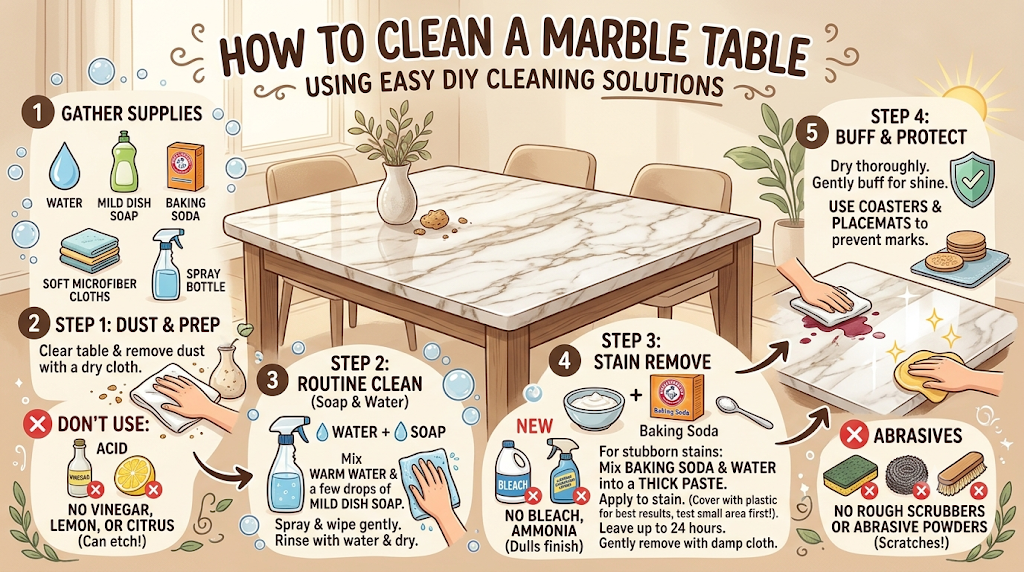
You don’t always need expensive products or professional help to keep your marble table clean. Everyday dust, fingerprints, food spills, and light stains can often be removed with simple household ingredients and a suitable stone cleaner. However, marble needs a little extra care because the wrong cleaning product or technique can leave scratches, dull spots, or etch marks on its surface.
We recommend to start with gentle DIY methods for regular cleaning and choosing specialized marble-safe products to buzz off stubborn stains. Here are some effective solutions you can use to clean your marble table.
1. Warm Water and Mild Dish Soap
Warm water mixed with a few drops of mild dish soap is one of the easiest ways to clean a marble table. This gentle solution remove everyday dirt, fingerprints, light grease, and food residue without exposing it to harsh chemicals.
Steps to use the warm water and mild dish soap:
- Add a few drops of mild dish soap to a bowl of warm water.
- Dip a soft microfiber cloth into the solution and wring out excess water.
- Gently wipe the marble tabletop to remove dirt and surface stains.
- Use another clean, damp cloth to remove any remaining soap residue.
- Dry the surface immediately with a soft microfiber towel.
This solution is best for everyday cleaning, removing fingerprints, buzz off the light grease, and if you have the food residue on the table.
Expert Call: We recommend to use a mild, pH-neutral dish soap and avoiding excessive water while cleaning.
2. Baking Soda Poultice for Stubborn Stains
If regular cleaning doesn’t remove stubborn stains from your marble table, a baking soda poultice may help lift some stains that have soaked into the stone. However, baking soda can be mildly abrasive, so it’s important to use it gently and carefully, especially on polished marble, to avoid affecting the surface finish.
How to use baking soda poultice to remove stubborn stains on marble table:
- Mix baking soda with a small amount of water to create a thick paste.
- Test the mixture on a small, inconspicuous area before applying it to the stain.
- Apply the paste gently over the affected area without rubbing or scrubbing.
- Cover it with plastic wrap and follow the recommended treatment time for the poultice.
- Remove the paste carefully, rinse with clean water, and dry the surface.
This solution is best for cleaning certain stubborn stains like absorbed oil and organic stains, depending on the marble type and finish.
What Mesh Maids Recommend: For expensive, polished, or delicate marble tables, we recommend using a commercially formulated marble poultice rather than experimenting with homemade mixtures. This helps reduce the risk of damaging the stone’s finish.
3. pH-Neutral Marble Cleaning Solution
For accumulated dirt, greasy residue, and stains that ordinary household solutions cannot remove, you can use a professional pH-neutral marble cleaning product. These cleaners are specifically formulated for natural stone and are suitable for regular marble maintenance.
How to use it:
- Choose a cleaning product labelled safe for natural marble.
- Read the manufacturer’s instructions for dilution and application.
- Apply the recommended amount using a soft microfiber cloth.
- Gently wipe the affected areas without applying excessive pressure.
- Rinse if required by the product instructions and dry the tabletop thoroughly.
This solution is best suited to remove stubborn everyday grime, grease, and to maintain marble on a regular basis.
We suggest keeping a pH-neutral marble cleaner at home for occasional deep cleaning. Always check the product label before use and avoid multipurpose cleaners that contain acidic ingredients.
Important: Never use vinegar, lemon juice, or acidic bathroom cleaners on marble. Their acidity can cause etching, leaving permanent dull marks on the surface.
NOTE – Preparing to clean your floor? Take help of our guide on how to clean floor with pH floor cleaner.
What Professional Cleaning Solutions Can You Use to Clean a Marble Table?
DIY cleaning methods work well for everyday dirt and light stains, but they may not be enough to lift stubborn grease, remove deep-set stains, or restore dull-looking marble. In such cases, specially formulated stone-care products can help to clean and maintain the surface. These products are designed for natural stone and offer a gentler alternative to harsh household cleaners when used according to the instructions.
At Mesh Maids, we recommend choosing products according to your marble’s finish and the type of buildup you want to remove. Here are some professional cleaning solutions you can consider.
1. Professional pH-Neutral Stone Cleaner
A professional pH-neutral stone cleaner is designed to remove dirt, grease, fingerprints, and everyday residue from natural marble without exposing it to acidic ingredients. You can use it for regular cleaning or when mild dish soap is not sufficient.
Step-by-step method to use professional pH-Neutral stone cleaner:
- Select a cleaner specifically formulated for marble.
- Follow the manufacturer’s dilution instructions.
- Apply it using a soft microfiber cloth.
- Gently wipe the tabletop to remove accumulated dirt.
- Rinse if directed and dry the surface with a clean towel.
Best suited for routine cleaning, greasy residue, and accumulated surface dirt.
2. Marble Stain Remover and Poultice
Professional marble stain removers and poultices are designed to address stains that penetrate beyond the surface. You can use depending on their formulation, they help to treat oil, food, and other absorbed stains that ordinary cleaning solutions cannot remove.
How to use marble stain remover:
- Identify the stain before selecting a suitable marble stain remover.
- Check that the product is compatible with your marble.
- Apply it according to the manufacturer’s instructions.
- Allow the recommended treatment time.
- Remove the product and rinse the area as directed.
It is best to remove stubborn oil stains, food stains, and certain deeply absorbed marks.
3. Marble Polishing Compound
Marble polishing compounds are used to improve the appearance of suitable marble surfaces and restore some of their shine. They are designed to improve the surface’s appearance and address minor dullness, but make sure the product is suitable for your marble type and finish before using it.
How to use marble polishing compound to upgrade the dullness:
- Choose a polishing compound specifically designed for natural marble.
- Follow the recommended application instructions.
- Apply it using the appropriate soft applicator or polishing pad.
- Buff the surface as directed without applying excessive pressure.
- Remove any remaining residue according to the product instructions.
It is best suited for to improve minor dullness and to maintain the appearance of polished marble.
NOTE* – If your marble table has noticeable etch marks, deep scratches, or uneven areas, it’s best to leave the restoration to stone-care professionals. Trying to fix these problems with aggressive polishing at home may cause further damage to the marble surface.
4. Professional Marble Sealer
A marble sealer helps to reduce how much liquid and other staining substances the stone absorbs. Since marble is naturally porous, applying a suitable impregnating sealer can offer extra protection against everyday spills and stains. However, keep in mind that sealing does not make marble completely stain-proof or protect it from acid etching.
Step-by-step guide to use professional marble sealer:
- Clean the marble thoroughly and allow it to dry completely.
- Select an impregnating sealer suitable for your marble type and finish.
- Apply the recommended amount using a clean applicator.
- Allow the product to penetrate for the specified time.
- Remove excess sealer before it dries on the surface, following the manufacturer’s directions.
From our experience, we recommend the use of it to reduce liquid absorption and protecting porous marble surfaces.
What Mesh Maids recommend: Before applying a fresh coat of sealer, check whether the existing seal is still effective. Follow the product’s care instructions or speak with a stone-care professional if you’re unsure whether your marble table needs resealing.
Not all marble stains are the same, and each needs a slightly different cleaning approach. Below, we’ll look at common stains on marble tables and what you can use to clean them safely.
How to Deal with Different Types of Stains on a Marble Table?
Not every stain on a marble table requires the same cleaning treatment. Coffee spills, oily food marks, cosmetics, and rust stains can affect marble differently. Using the wrong cleaning solution may spread the stain or damage the stone’s polished finish. We recommend to first identify the type of stain and then choose a suitable marble-safe treatment.
1. Coffee and Tea Stains
Coffee and tea spills can leave brownish stains on marble if they are not cleaned up quickly. If you notice a spill, gently blot it with a clean cloth instead of rubbing, as rubbing can spread the liquid further. Once the spill is absorbed, wipe the area with a pH-neutral marble cleaner. For stains that have already soaked into the stone, a suitable poultice designed for organic stains may help lift the discolouration.
2. Oil and Grease Stains
Food oils, butter, cooking grease, and oily cosmetics can leave dark patches on marble as they seep into its porous surface. For fresh spills, gently wipe away the residue using a marble-safe degreasing cleaner. If the oil has already soaked into the stone and left a dark mark, an oil-stain poultice can help draw it out. We recommend to choose a commercially formulated product that is suitable for your type of marble and follow the instructions carefully.
3. Ink and Makeup Marks
Ink, lipstick, foundation, and other makeup products can leave stubborn marks on marble tabletops. If you notice a fresh stain, gently blot the area with a clean cloth rather than scrubbing it, as this can spread the residue. For marks that remain, Mesh Maids suggest to use a stain remover that is safe for marble and suitable for the type of stain you’re dealing with. Always check the product instructions before applying it to the surface.
4. Rust Stains
Metal décor, candle holders, and other accessories can leave rust stains on marble when moisture gets trapped underneath them. These marks are often difficult to remove with regular household cleaners. If you notice rust spots, choose a rust remover specifically designed for marble. Avoid regular rust removers, as many contain acids that can damage the stone and leave permanent etch marks.
As industry experts, we recommend that if a stain doesn’t come out after trying the right cleaning method, it’s best to consult a stone-care professional. Deep stains and chemical etch marks need different treatments, so it’s important to identify the problem before trying another cleaning solution. This helps avoid further damage to your marble table.
How Should You Maintain a Marble Table After Cleaning? Expert Maintenance Tips
Cleaning your marble table removes existing dirt and stains, but regular maintenance helps preserve its appearance between cleaning sessions. A few simple habits can prevent spills, scratches, and residue from affecting the stone’s natural finish.
Here are some practical maintenance tips we recommend following:
1. Use Coasters and Placemats
Place coasters under coffee cups, glasses, and beverage containers to prevent accidental spills and moisture rings. Use mats during meals to protect dining tables from food residue, cutlery scratches, and spills.
2. Wipe Spills Immediately
Clean coffee, juice, sauces, and oily food spills as soon as possible. Blot the affected area with a soft cloth instead of rubbing the liquid across the surface. This reduces the chance of staining and prolonged contact with potentially damaging substances.
3. Dust the Surface Regularly
Use a clean, dry microfiber cloth to remove dust and loose particles from your marble table. Regular dusting prevents dirt from accumulating and reduces the risk of fine scratches caused by rubbing abrasive particles against the surface.
4. Protect the Table from Decorative Accessories
Vases, metal candle holders, flowerpots, and decorative objects can leave scratches, rust marks, or moisture stains. We recommend placing protective felt pads or suitable mats underneath these accessories.
5. Check the Marble Sealer Periodically
If your marble table has been sealed, check whether its protective treatment needs refreshing. The frequency depends on the stone, sealer, and amount of use. Consult the manufacturer’s instructions or a stone-care professional before applying another coat.
6. Schedule Professional Stone Maintenance When Needed
If your marble table develops persistent dull patches, visible etching, or deep scratches, ordinary household cleaning may not restore its appearance. We recommend consulting a professional stone-restoration specialist to assess whether polishing, honing, or another treatment is appropriate.
One cleaning Tip: Make gentle dusting and immediate spill cleanup part of your regular household routine. These small habits can help keep your marble table looking attractive and reduce the need for intensive cleaning.
Dealing with sofa stains? Check out our blog on how to how to clean sofa stains for every fabric type.
What Common Mistakes Should You Avoid While Cleaning a Marble Table?
Marble requires more careful handling than many other furniture surfaces, whether it is a leather sofa. Even small cleaning mistakes can affect its natural finish, cause etching, or leave marks that are difficult to remove. Based on our cleaning knowledge and experience, we recommend paying attention to the following mistakes when maintaining marble tables.
1. Treating Etching as an Ordinary Stain
One common mistake is trying to remove every dull mark with a regular stain remover. However, etching is a chemical reaction that affects the marble’s surface, rather than dirt sitting on top of it. For example, spilled lemon juice or vinegar can leave dull patches that do not disappear with ordinary cleaning.
What you should do: Identify whether the mark is a stain or etching before choosing a treatment. We recommend consulting a stone-care specialist if the marble has visible etching or a damaged polished finish.
2. Using the Same Cleaner for Every Type of Marble
Not every marble table has the same finish or cleaning requirements. Polished marble, honed marble, and textured marble can respond differently to cleaning products and treatments.
You should check your marble’s finish and the manufacturer’s care instructions before selecting a cleaner. Choose a product specifically formulated for your type of natural stone.
3. Ignoring the Edges and Underside of the Tabletop
Dust, food particles, and sticky residue can accumulate around table edges, corners, joints, and underneath the tabletop. Cleaning only the visible part leave dirt behind, particularly on frequently used dining tables.
What you should do: Include the edges, corners, and accessible underside in your cleaning routine. Use a soft microfiber cloth to reach these areas without scratching the marble.
4. Applying Polish to Hide Scratches and Dull Patches
Applying additional polish whenever marble loses its shine is not always the right solution. Surface scratches, etching, product residue, and worn finishes require different treatments. Using an unsuitable polishing compound can create uneven patches or leave additional residue.
What you should do: Identify the reason behind the dullness before applying a polishing product. We recommend professional assessment for noticeable scratches, etching, or uneven finishes.
5. Using a Sealer Without Checking the Existing Protection
Applying multiple layers of marble sealer does not necessarily provide better protection. Excess product can leave a cloudy or sticky film, particularly when it is not removed according to the manufacturer’s instructions.
What you should do: Check whether your marble actually needs resealing. Follow the sealer manufacturer’s instructions or consult a stone-care professional before applying another treatment.
6. Allowing Cleaning Products to Dry on the Surface
Leaving cleaning solutions, soap, or stain removers on marble longer than instructed can cause residue buildup and sometimes affect the finish. This is particularly important when using concentrated professional stone-care products.
What you should do: Follow the recommended application and contact time for each product. Remove the solution as directed and dry the tabletop with a clean microfiber cloth.
What Are the Expert Tips from Mesh Maids for Cleaning a Marble Table?
Cleaning marble furniture is not just about removing visible dirt. The way you prepare the surface, identify marks, select cleaning products, and handle delicate edges can make a significant difference to the final result. We recommend following a few additional precautions that are often overlooked during routine house cleaning.
Here are our expert tips to help you clean marble tables more carefully and maintain their natural finish.
1. Remove Loose Dust Before Using a Damp Cloth
One detail you should not overlook is removing loose dust and tiny particles before wiping the marble. Small particles of sand, grit, and debris can create fine scratches when rubbed against a polished surface.
Mesh Maids Tip: First, gently remove loose particles using a clean, dry microfiber cloth. Once the surface is free of dust, use a separate damp cloth with a marble-safe cleaning solution. This two-stage approach helps reduce unnecessary friction.
2. Check the Marble Under Different Lighting Before Cleaning
Some marks are difficult to identify under ordinary room lighting. A surface may appear clean from one angle but show dull patches, streaks, or residue when natural light falls across it.
Our tip: Before cleaning, inspect the tabletop from different angles, preferably near a window or under side lighting. This helps you identify whether you are dealing with surface dirt, dried residue, scratches, or possible etching before choosing a cleaning treatment.
3. Use Two Separate Microfiber Cloths for Better Results
Using the same cloth for applying cleaner and drying the marble can redistribute dirt and leave streaks. It is particularly important to avoid transferring residue from one section to another.
Keep two clean microfiber cloths available:
- Use the first slightly damp cloth to apply the cleaning solution and loosen dirt.
- Use the second clean, dry cloth to remove moisture and buff away remaining streaks.
We recommend changing the cloth if it becomes visibly dirty rather than continuing to wipe the entire tabletop with it.
4. Pay Attention to the Areas Around Decorative Objects
Marble tables often have decorative accessories such as flower vases, candle holders, photo frames, and centrepieces. Moisture trapped underneath these objects can leave rings, while metal accessories may cause rust marks.
Remove decorative objects before cleaning and inspect the areas underneath them. Check for moisture, rust-coloured marks, and accumulated dust. Dry the tabletop completely before returning the accessories, and use protective pads underneath them.
5. Avoid Using Excessive Cleaner to Achieve a Shiny Finish
Applying more cleaning solution does not necessarily produce better results. Excess soap or concentrated stone cleaner can leave a thin residue that makes the marble look cloudy or streaky.
Our tip: Follow the recommended dilution and application instructions instead of pouring cleaner directly onto the tabletop. If the surface still looks dull after cleaning, check for product buildup or etching rather than repeatedly applying more cleaner.
6. Test the Marble’s Water Absorption Before Considering Resealing
A marble table may have an existing impregnating sealer, but its protective performance can change over time. Applying another coat without checking the existing condition can lead to unnecessary product buildup.
Our tip: Ask your stone-care professional to assess the existing sealer. A suitable water-drop assessment on an inconspicuous area may help indicate whether the stone is absorbing moisture, although it should not replace the manufacturer’s sealing guidance.
Remember that a sealer helps reduce absorption but does not prevent acid etching.
7. Do Not Confuse a Dull Patch With a Cleaning Problem
This is particularly important when dealing with polished marble. If a section looks cloudy or has lost its shine, stronger cleaning products may not solve the problem.
Our tip: Inspect the affected area carefully. If the surface feels rough or appears dull in comparison with the surrounding marble, it may be etched rather than dirty. We recommend consulting a stone-restoration specialist to determine whether honing or repolishing is necessary.
8. Keep Marble and Glass Cleaning Supplies Separate
If your furniture combines marble and glass, avoid using the same cleaning solution or cloth on both materials. A glass cleaner containing vinegar may be suitable for ordinary glass but can damage the surrounding marble.
Our tip: Use a dedicated marble-safe cleaner and separate microfiber cloths for each material. When cleaning glass attached to a marble frame, apply the glass cleaner to the cloth away from the stone and prevent liquid from running onto marble edges.
We suggest treating every marble table according to its stone type, finish, and existing condition rather than following a one-product-fits-all cleaning routine. Gentle preparation, careful product selection, and proper drying can make everyday maintenance much easier. Contact us if you need help keeping your home clean and well-maintained. Our team at Mesh Maids is here to help with your cleaning needs.
If you’re planning for the first time to hire professional cleaners, check out our blog on how much does house cleaning costs in Richmond Hill.
Conclusion
Through this guide, you now know how to clean a marble table using simple DIY remedies, professional stone-cleaning products, and the correct techniques for treating different types of stains. From removing everyday dirt and fingerprints to addressing stubborn grease, dull patches, and absorbed stains, choosing the right cleaning approach helps to protect your marble table from unnecessary damage.
We recommend following the expert tips, avoiding common cleaning mistakes, and maintaining your marble table with gentle, regular care. Whether you have a marble dining table or a decorative coffee table, these cleaning methods can help you preserve its natural beauty, polished finish, and elegance for years to come.
Let us take cleaning off your to-do list. Schedule your service with Mesh Maids today!